
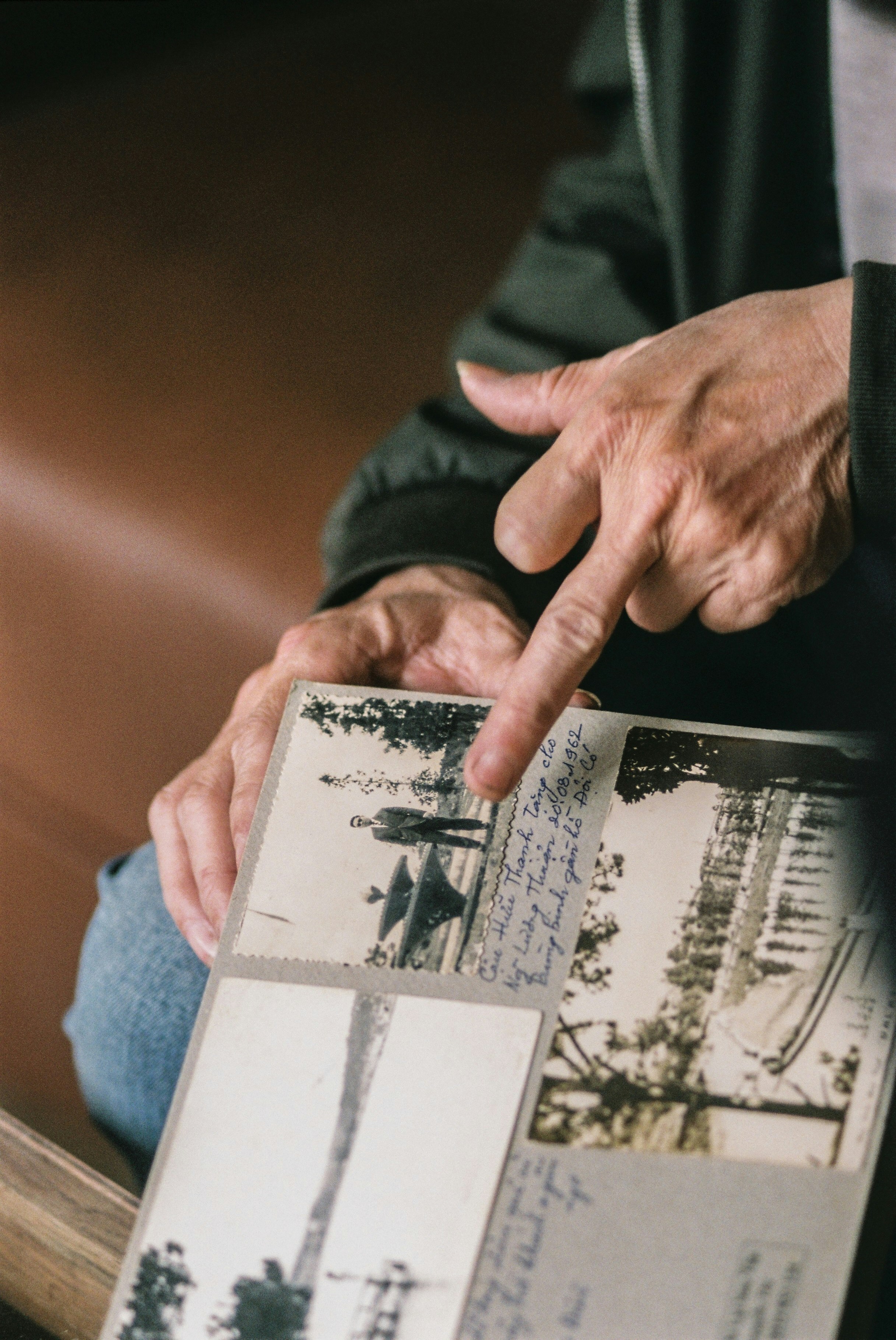
Do you know what your mum’s first job was?
What about the street your dad grew up on, or the song he put on when he thought nobody was listening?
Most of us know our parents as they were while we were growing up, and very little of who they were before that. It’s not that we don’t care, we just never ask, and then the years go by and the questions fade.
The good news is you don’t need a studio or a plan to fix it. You need a phone, an hour, and a way of starting the conversation that doesn’t feel like an interview.
Starting is the hard bit
Walking in and announcing “I’d like to record your life story” is the quickest way to get “oh, don’t be daft.” It sounds like a school project, or like a lot of work for them.
Don’t announce it. Start with something in the room: a photo on the mantelpiece, an old record. Ask about that one thing (“who’s that with you in this one?”) and let the story find its own way. People who’d never tell their life story will happily explain a photograph.
If they say “nobody wants to hear all that,” which they might, the answer is “I do.” Say it plainly and move on to the next question.
Once they’re a few minutes into a story, say you’d love to keep it and ask if you can set your phone down. Ask first, because they’ll forget it’s there within about two minutes, and that’s when you get the good stuff.
Getting a decent recording
Twenty years of cleaning up recordings has taught me that most problems come from the room, not the phone. Your phone is perfectly good, so the thing to get right is where you put it.
Pick the soft room. The kitchen is where everyone ends up, and it’s the worst place to record: hard walls and tiles bounce the sound around, and the fridge hums away underneath, so everything ends up sounding like a bathroom. The sitting room is better, because sofas, curtains and carpet soak up the echo.
Turn the noises off. Before you start, switch off the TV, the dishwasher and anything else that hums. Then stop and listen for a few seconds. You’ll probably hear sounds you stopped noticing years ago. Put the phone on aeroplane mode too, so a call doesn’t land in the middle of the best story.
Put the phone on something soft. Prop it on a cushion or a folded towel, about a foot from them and pointing at their mouth. On a bare table it picks up every cup, tap and elbow knock. And don’t hold it, since handling makes noise and it turns the whole thing back into an interview.
Do a quick test. Record a minute of chat about nothing, then play it back with headphones if you have them. If you can hear them clearly, you’re ready, and if you can’t, move the phone closer.
Stay quiet while they talk. It’s the hardest tip and the one that matters most. We all say “mm” and “yes” and “oh really?” while someone’s speaking, and on a recording it lands right over their words and ruins the clip. Nod instead, and let the gaps sit. The best answers tend to come after a pause, when they think you’ve finished and carry on anyway.
What to ask
Here are a few ideas for questions worth asking. Aim for interesting ones rather than playing “where were you born?” and “where did you grow up?”, which is the boring stuff that gets you a one-word answer. A good question gets them telling a story.
- What was your first job?
- What were your dreams when you were younger?
- What did you get up to on a Saturday night when you were seventeen?
- Is there a song that you relate to your youth?
- What’s the daftest thing you ever did?
- What do you know now that you wish you’d known at twenty?
- What do you remember about the day I was born?
Whatever they answer, the best follow-up is “and what happened next?” You’ll get more from that than from any question on this list.
What to do with it afterwards
Back it up the same day. Send it to yourself, send a copy to a sibling, and put it somewhere that isn’t only your phone. The original recording can never be replaced.
A phone recording is worth having, and it’s far better than nothing. But it’s raw. It’s one long take with the odd cough and you saying “mm” over the best bit. The stories wander and loop back, there’s no beginning or end, and there’s no music.
What I make is a different thing. I start with a proper recording on professional equipment, so the voice is clear from the first second. Then I shape it into something with a beginning, a middle and an end, with music and sound design underneath. It’s the difference between a home video and a documentary, and one the whole family would choose to sit down and listen to together.
That’s Legacy Tracks. I come to your parent’s home, record them there, and do all of that afterwards. I’m currently recording in London and the surrounding areas.